
Maternity, paternity and adoption leave and allowances
Parents who are gainfully employed are entitled to paid leave following the birth or adoption of their child. Income compensation allowances (IC) partially cover the income lost by parents during their leave of absence to care for their new child.
Eligibility criteria
Following the birth or adoption of your child, you are entitled to an income compensation allowance (IC) if:
- you are in salaried employment or are self-employed;
- you have paid IC contributions for at least nine months prior to the birth or adoption of your child; and
- you were in paid work for at least five of those nine months.
- The adopted child is younger than four.
If you are unemployed or unable to work, you are entitled, under certain circumstances, to an allowance following the birth or adoption of your child.
Benefits
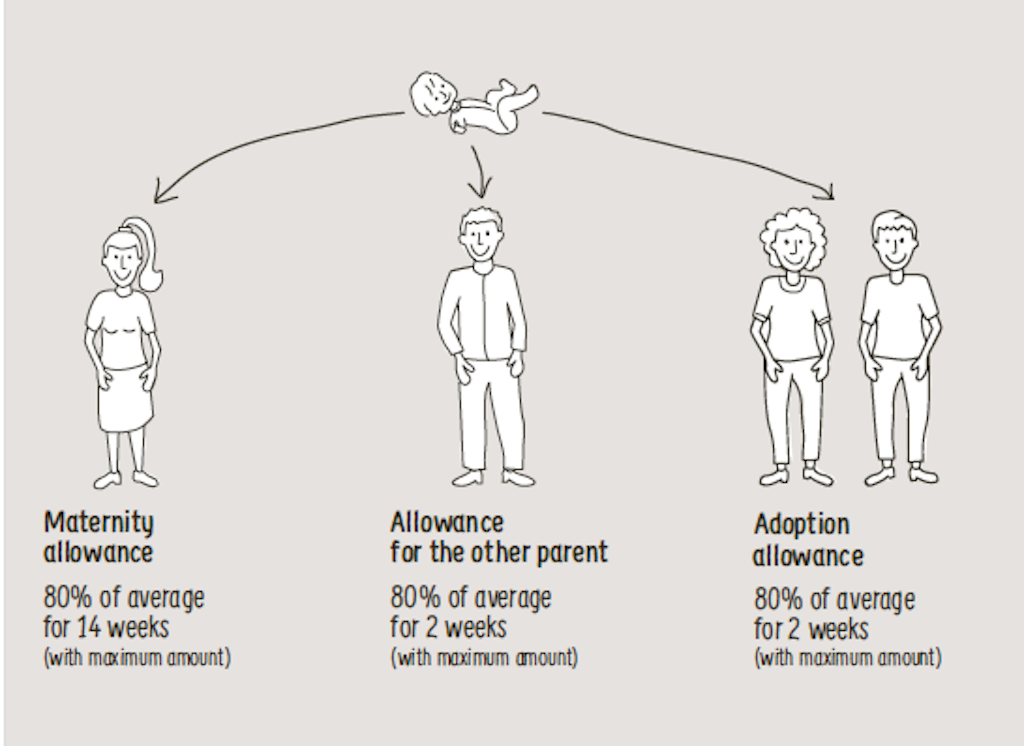
The income compensation insurance (IC) provides three types of parenthood-specific allowances: a maternity allowance, an allowance for the other parent/paternity allowance and an adoption allowance.
Maternity allowance
Any woman who is in gainful employment and gives birth is entitled to 14 weeks of paid maternity leave. This is covered by the IC and compensates for up to 80% of the mother's average income prior to the birth of the child (max. CHF 220 per day). Maternity leave must be taken in one go and immediately after the child is born.
Informations about maternity protection in Switzerland:
in German: Mutterschutz
in French: Protection de la maternité
in Italian: Protezione della maternità
Allowance for the other parent (father or mother’s wife)
Fathers who are in gainful employment are entitled to two weeks' paid leave following the birth of their child. This is covered by the IC and compensates for up to 80% of the father's average income prior to the birth of the child (max. CHF 220 per day). Paid paternity leave must be taken in the six months following the birth, either in one go or as individual days (total of 10 working days).
The wife of a woman who has given birth has the same rights as a legal father. She receives the allowance for the other parent if she was married to the mother at the time of the birth and that the child was conceived through a sperm donation.
Adoption allowance
Individuals in gainful employment who adopt a child under the age of four are entitled to two weeks' paid adoption leave. The adoptive parents can share this leave as they see fit. The allowance compensates for up to 80% of the average income prior to the official adoption of the child (max. CHF 220 per day). Leave can be taken in one go or as individual days within the 12 months following the adoption.
Contributions
If you live or work in Switzerland, you have to pay IC contributions from 1 January following your 20th birthday. If you are already in paid work, this obligation begins at the age of 17. The same applies to individuals who remain in paid work beyond the reference age. IC contributions are deducted at the same time as contributions for old-age and survivor’s insurance and invalidity insurance.
- As an employee, you pay half of these contributions. Your employer pays the other half.
- If you are self-employed, your contributions are calculated on the basis of your earnings for the contribution year.
- If you are not in paid work, you still have to pay IC contributions. These are calculated based on your assets and/or your annual pension income.
More information on contributions: Overview of Swiss social security contributions
Application process
If you are employed, your employer submits the application to the competent OASI office.
If you are self-employed or not in paid work, you need to submit your maternity/paternity/other parent allowance application to your OASI office.
Applications for an adoption allowance must be sent to the Federal Compensation Office.
Contact
List of OASI offices:
Contacts | OASI/DI Information Center
Further information
Leaflets : LEC / Matenity - other parent - adoption - assistance | Leaflets | Information Center OASI/DI